The World of Art Nouveau
Picture yourself in Paris, 1899.

You’re traveling down a cobbled street, surrounded by passing horse carriages. Around you, you notice stylish French ladies in wide-brimmed hats and swishing skirts walking hand in hand with gentlemen in tailored suits. On the corner, a metro entrance is heralded by a twisting wrought iron gate. You look up to see a brand new electric streetlight buzz to life, and farther in the distance a giant brightly lit sign advertising the showgirls of the Folies-Bergere and the Moulin Rouge.
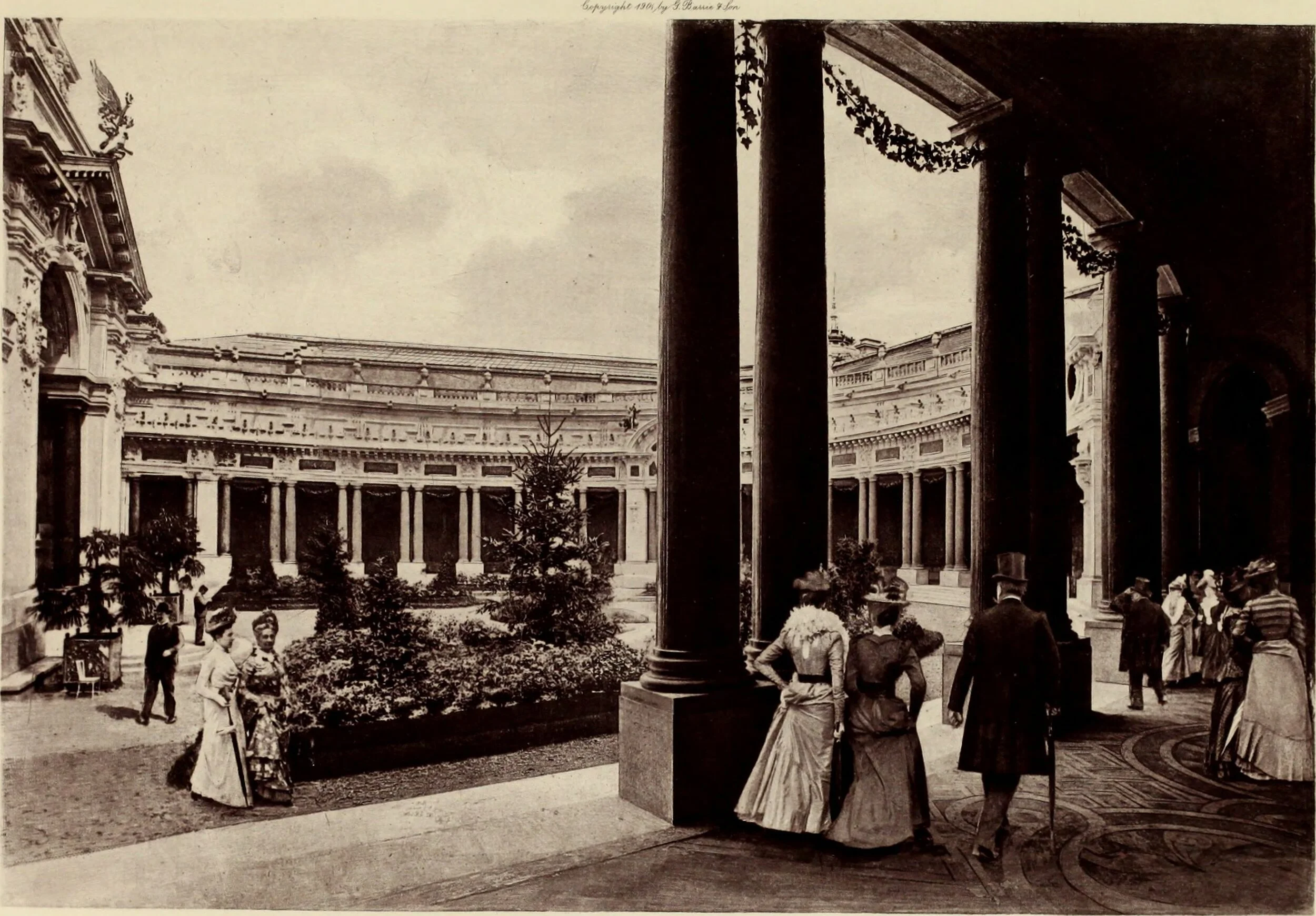
A snapshot of the Universal Exposition of 1900, Paris
It’s the turn of the 20th century, and Paris is the world’s center of art and design. The city will soon host the Exposition Universelle in 1900, thrusting the art movement known as art nouveau into the spotlight and setting the stage for famous designers of this era such as René Lalique, Hector Guimard, and Alfons Mucha.

Alfons Mucha, Winter, 1896

Alfons Mucha, Spring, 1896
Art Nouveau design was in its heyday from 1890-1915. Characterized by themes of nature and fantasy, flowing lines and opulent curves, and influences from Japan, the Art Nouveau movement is a representation of the wealth and opulence of the late 1890s and early 1900s in Europe.

Ivory orchid comb by René Lalique, 1903
In particular, Art Nouveau jewelry is a remarkable departure from the Victorian designs of the 19th century. Rather than continuing with the gothic and bold jewelry designs of previous decades, designers of the Art Nouveau era instead chose to implement delicate, sinewy curves and use colored gemstones and enamel to create pieces that conveyed the natural forms of flowers and insects.
Heralded designers of this age like Lalique created pieces for the most famous women of the era to wear, the most notable being singer Sarah Bernhardt. Because of the art movement’s striking uniqueness compared to the decades prior, Art Nouveau pieces were seen as high art, to be worn by the elite women of Parisian society. However, as with most modern art and design movements, its popularity became widespread, and soon the features of Art Nouveau jewelry could be seen in almost every jeweler’s shop window.

A jewelry advertisement from 1919. The jewelry featured in this ad draw from not only the preceding Art Nouveau movement but the upcoming Art Deco period.
Shop Our Collection
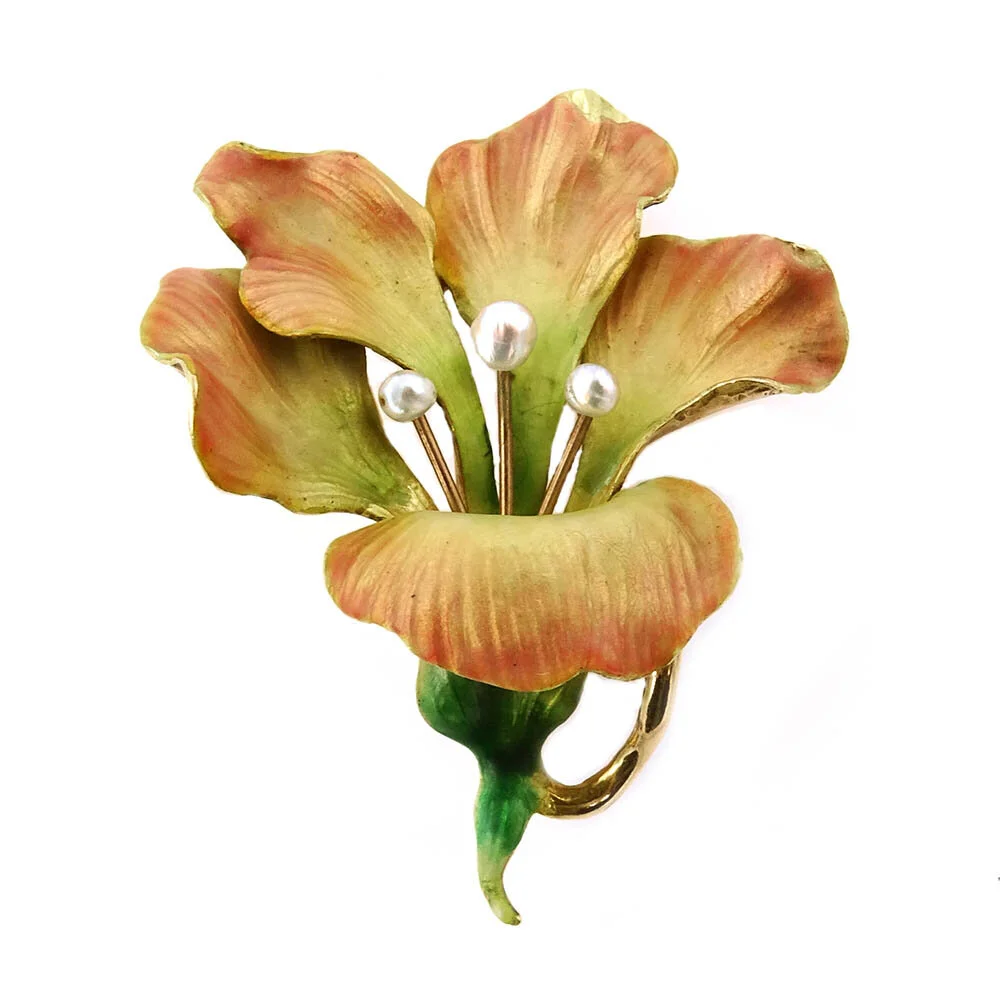
Life-like, undulating satin flower petals are featured in this beautiful Art Nouveau (1890-1910) brooch pin. Gold filaments topped with pearl anthers create the stamen to complete the realism of the piece. Adorn yourself with this everlasting boutonniere and keep the joys of Spring alive throughout the year.
Metal Type: 18 karat yellow gold
Gemstone Information: Three approximately 3mm variously shaped pearls
Brooch Measurements: 1-1/4 x 1-3/4 inches
Weight: 7.4 grams
Item Number: 506-00070
Mounted gemstones cannot be measured exactly, therefore, carat weight is considered approximate unless accompanied by certification from an independent lab, such as SGL or GIA. Colored gemstones and pearls are often enhanced, unless documentation says otherwise.
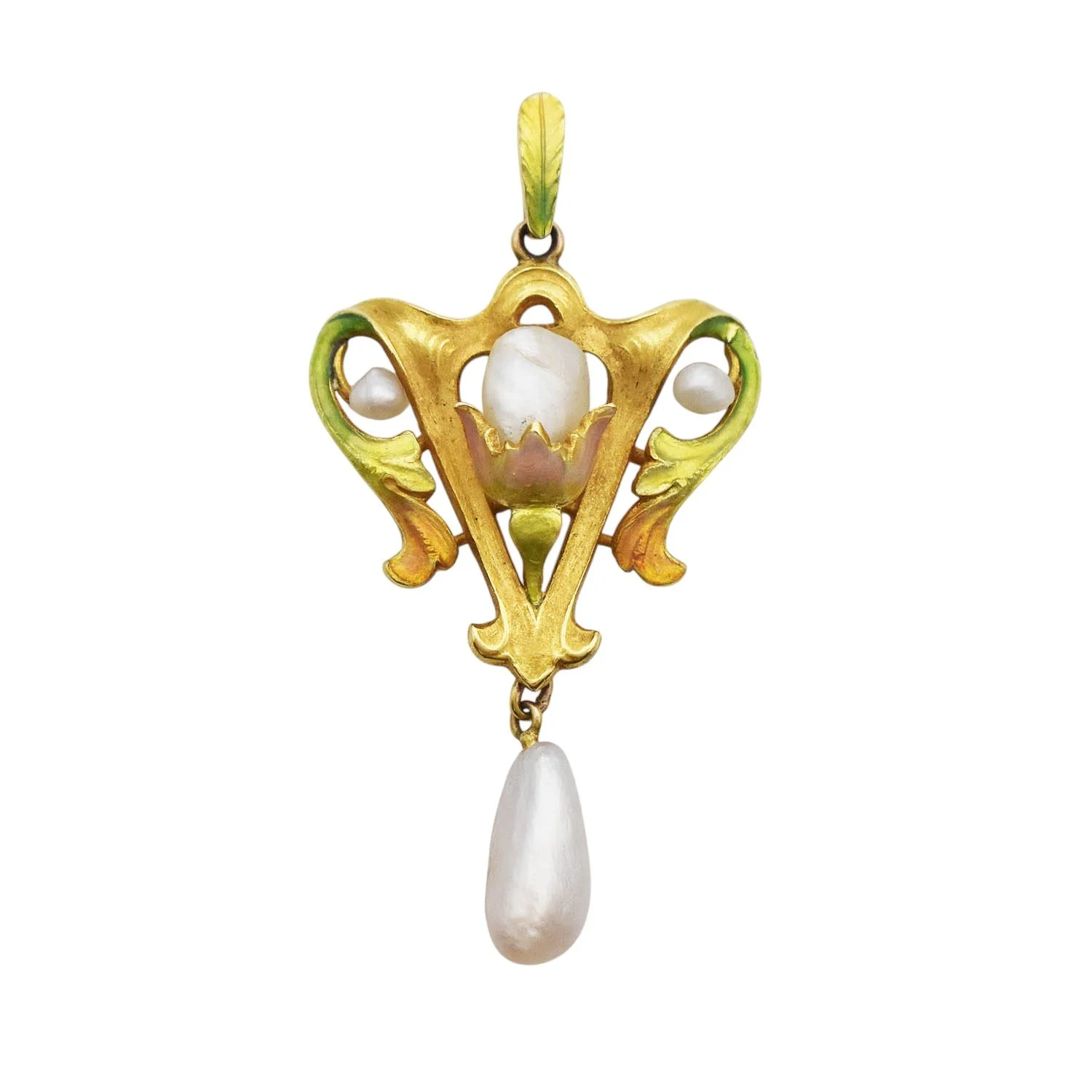
The charming look of this Art Nouveau (1890-1910) pendant is indicative of the time period. Pastel pink, green and orange enamel wisp softly over the yellow gold organic design. The freeform freshwater pearls are the perfect highlight to adorn the openwork form.
The chain is sold separately.
Metal Type: 14 karat yellow gold
Gemstone information: Pearls measure 11.2 × 5mm, 8.8 × 6mm and 3mm, largest to smallest
Measurements: 43 × 22.5mm long with bail
Weight: 3.5 grams
Item Number: 502-00069
Mounted gemstones cannot be measured exactly, therefore, carat weight is considered approximate unless accompanied by certification from an independent lab, such as SGL or GIA. Colored gemstones and pearls are often enhanced, unless documentation says otherwise.
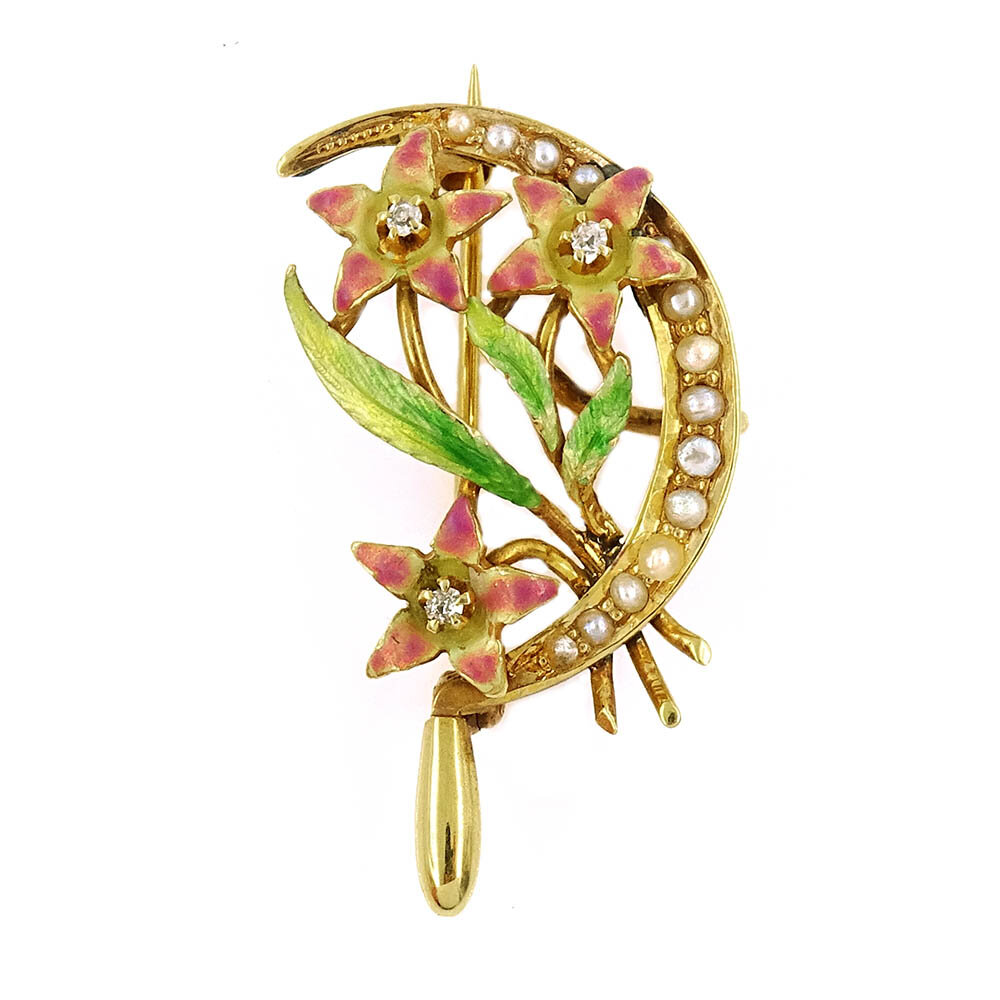
This pin brooch features a sickle with graduated seed pearls and is adorned with a triplet of enameled flowers with diamond centers. A wonderful example of Art Nouveau (1890-1910) styling, this pin is fun to wear and a conversation piece!
Metal Type: 14 karat yellow gold
Gemstone Information: Fifteen graduated seed pearls, and three round diamonds with a total carat weight of 0.02
Measurements: 1-1/4 inches x 5/8 inch
Weight: 3.6 grams
Item Number: 506-00073
Mounted gemstones cannot be measured exactly, therefore, carat weight is considered approximate unless accompanied by certification from an independent lab, such as SGL or GIA. Colored gemstones and pearls are often enhanced, unless documentation says otherwise.
Sources:
Collectors Weekly - Art Nouveau Jewelry
National Jeweler - The History Behind Art Nouveau Jewelry
Christie’s - Collecting guide: Art Nouveau jewellery
Lalique.com - Lalique timeline